
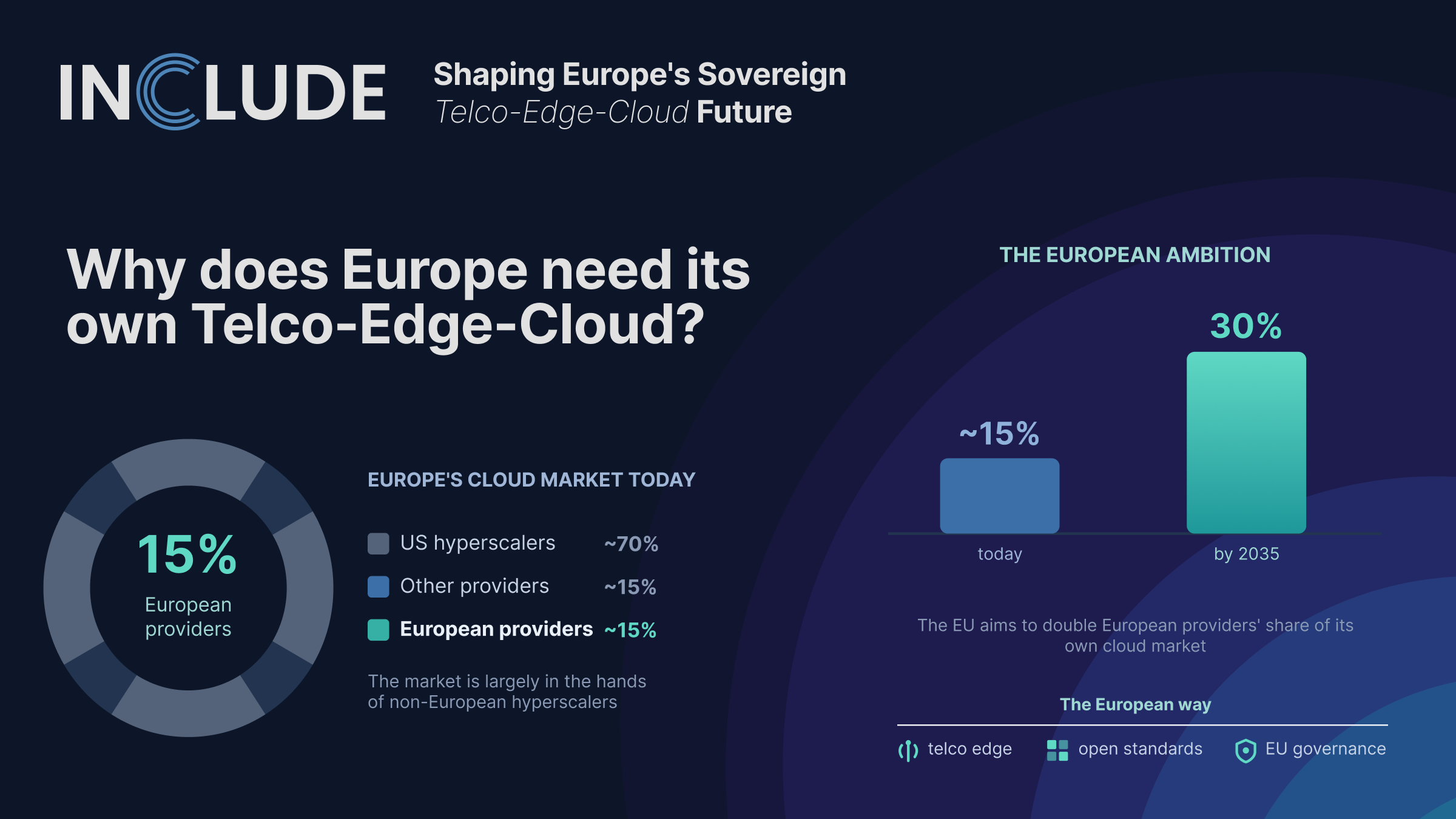
Here is a number worth pausing on. Today, European providers hold around 15% of Europe's own cloud market. The rest sits largely in the hands of non-European hyperscalers.
For a continent that increasingly runs its economy, its public services and its daily life on digital infrastructure, that figure raises an important question: who really controls the foundations of Europe's digital future?
A gap the EU wants to close
The European Commission has been clear about the stakes. In its impact assessment for the Cloud and AI Development Act, the baseline scenario is stark: without change, European providers stay stuck at around 15%, with a pessimistic path sliding towards 10%.
To change that trajectory, the EU has set a clear ambition: to raise European providers' share to 30% of the European market by 2035. Reaching it means giving European industry and citizens a genuine choice over where their data lives, who governs it, and on whose terms the digital economy of the next decade is built.
Competing on Europe's own strengths
Matching the global hyperscalers on sheer scale and capital would be a steep climb. The more promising path runs through the areas where Europe already holds real advantages: its world-class telecom networks, its industrial base, and its long-standing commitment to openness and shared standards.
This is the promise of the Telco-Edge-Cloud: computing that lives closer to where data is created, woven directly into Europe's connectivity networks, built on open-source foundations, and governed under European rules. It offers a model of digital infrastructure that reflects European values while remaining open to the world.
Why coordination is the missing piece
Europe does not lack talent, technology or ambition. What has held its providers back is fragmentation. Strong players, working separately, cannot achieve what the same players can accomplish when they pull in the same direction.
That is precisely the gap the 3C Initiative exists to close, and where the INCLUDE project plays its part. By aligning Europe's supply-side and demand-side communities around a converged technology roadmap, a shared governance framework, and a common catalogue of trusted building blocks, INCLUDE helps turn a collection of individual efforts into a coherent, competitive European ecosystem.
Sovereignty, in the end, comes down to choice. A strong European Telco-Edge-Cloud gives the continent the freedom to decide how its digital future is built, and by whom.
Sources: European Commission impact assessment, Cloud and AI Development Act (2026).